If you’re wondering whether your locks can be rekeyed instead of replaced, you’re asking the right question. Rekeying is almost always cheaper than replacing the entire lock, but not every lock can handle it. Some work perfectly, some need special parts, and some can’t be rekeyed at all.
Here’s what actually determines whether your locks can be rekeyed – and what to do when they can’t.
Which Locks Can Be Rekeyed?
Most standard pin-and-tumbler locks can be rekeyed. These are the locks you see on most homes, offices, and some vehicles. If your lock uses a physical key with grooves or cuts, there’s a good chance it can be rekeyed.
Locks That Can Usually Be Rekeyed
- Standard deadbolts – Kwikset, Schlage, Baldwin, Weiser
- Doorknob locks – most residential entry and interior knobs
- Commercial-grade locks – mortise locks, Adams Rite, Von Duprin exit devices (if keyed)
- Padlocks – high-security brands like American Lock, Master Lock Pro Series
- File cabinets and desks – cam locks and tubular locks with removable cores
- Some vehicle locks – older model car doors and ignitions (pre-2000s mostly)
Locks That Can’t Be Rekeyed
- Cheap hardware store locks – off-brand or no-name locks often don’t have removable cores or replacement pins available
- Certain wafer locks – some use non-standard wafer stacks that can’t be reconfigured
- Electronic smart locks without physical keys – fully digital locks just need reprogramming, not rekeying
- Damaged or corroded locks – if the cylinder is seized or badly worn, rekeying won’t fix the mechanical problem
- Most modern car ignitions – transponder systems and push-to-start don’t use traditional pin-and-tumbler cylinders
The big exception: high-security locks can almost always be rekeyed, but they require proprietary pins and tools. Brands like Medeco, Mul-T-Lock, and ASSA use restricted keyways — we can rekey them, but you can’t buy the parts at a hardware store.
Why Some Locks Fail the Rekey Test
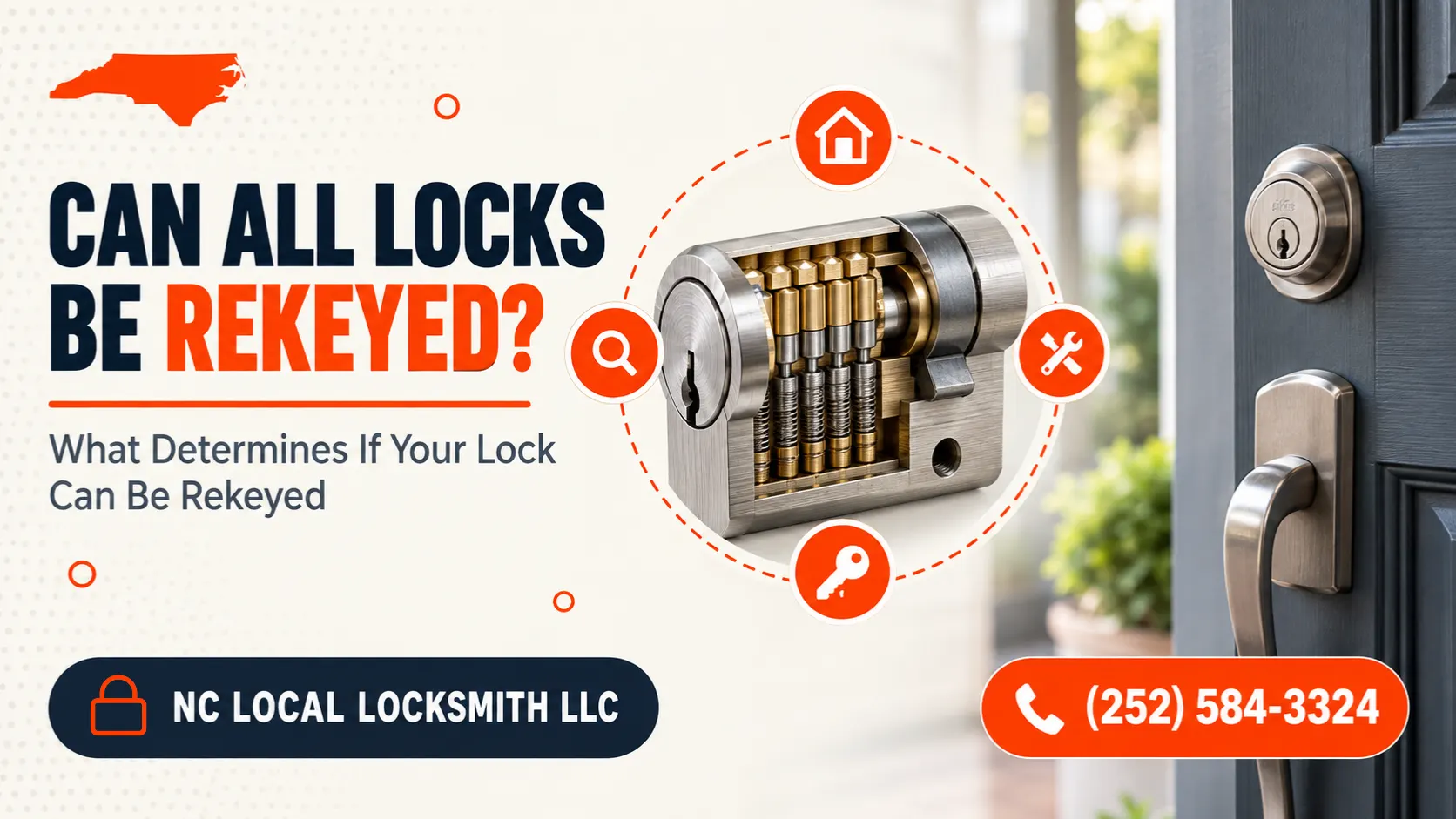
Rekeying means taking the lock cylinder apart, removing the old pins, and installing new ones that match a different key. That only works if the lock was built to be serviceable.
No Access to the Cylinder
Some locks are built as sealed units. You can’t remove the cylinder without destroying the lock housing. This is common in cheap builder-grade knobs and older vehicle door locks.
Non-Standard Pin Sizes
Off-brand locks sometimes use proprietary pin sizes that aren’t available aftermarket. If we can’t source replacement pins, we can’t rekey it.
Internal Damage
If the lock has been forced, drilled, or heavily corroded, the pin chambers might be damaged. Rekeying won’t fix bent springs, stripped threads, or misaligned cylinders. At that point, replacement is the only option.
When Rekeying Doesn’t Make Sense
Sometimes rekeying isn’t worth it even when the lock technically allows it. If the lock is old, wobbly, or cheap to begin with, spending money on rekeying is just polishing a broken tool.
You’re better off replacing the lock entirely if:
- The lock is more than 15 years old and showing wear
- It’s a builder-grade lock that was installed for minimum cost
- The bolt doesn’t fully extend or retracts inconsistently
- You’re upgrading to smart locks anyway
What About Smart Locks?
Smart locks that still use a physical key cylinder can be rekeyed just like a standard lock. Models like the Schlage Encode or Kwikset Premis have backup key access – we rekey the mechanical cylinder while leaving the electronics untouched.
Fully keyless smart locks don’t need rekeying. You just delete the old user codes or disable the old smartphone credentials in the app.
Cost to Rekey vs. Replace
| Service | Typical Cost | Best For |
|---|---|---|
| Rekey single lock | $20–$40 | Lock is in good shape, just need new key control |
| Rekey whole house (5 locks) | $100–$150 | Moving into a new home with quality existing locks |
| Replace single lock | $75–$200 | Lock is damaged, outdated, or low-quality |
| Replace + install high-security lock | $150–$350 | Need better protection or restricted keyway |
Rekeying makes sense when the locks are solid and you just need different keys. Replacement makes sense when you’re fixing a security problem or upgrading hardware.
Frequently Asked Questions
Can I rekey a lock myself?
Technically yes, if you buy a rekeying kit and the lock is a common brand. But one mistake – dropping a spring, mixing up pin sizes, damaging the cylinder – and you’ve turned a $30 service call into a $150 lock replacement.
Can all locks be keyed alike?
Only if they’re the same brand and keyway. You can’t key a Schlage and a Kwikset to the same key because their keyways are physically different. But if all your locks are the same brand, we can rekey them so one key opens everything.
How long does rekeying take?
About 10–15 minutes per lock once we’re on site. If you’re rekeying a whole house, we can usually finish in under an hour.
Will rekeying damage my lock?
Not if it’s done correctly. We disassemble the cylinder, swap the pins, and reassemble it. The lock works exactly the same – just with a different key.
Can you rekey a lock without the original key?
Yes, but it’s more time-consuming. We either pick the lock open or disassemble the cylinder to measure the existing pins. It adds 10–20 minutes to the job but doesn’t change the outcome.
Ready to get started?
NC Local Locksmith LLC is here to help with can all locks be rekeyed. Reach out today and we’ll walk you through your options, answer your questions, and book a time that works for you.
Call (252) 584-3324 or fill this form to schedule your appointment.